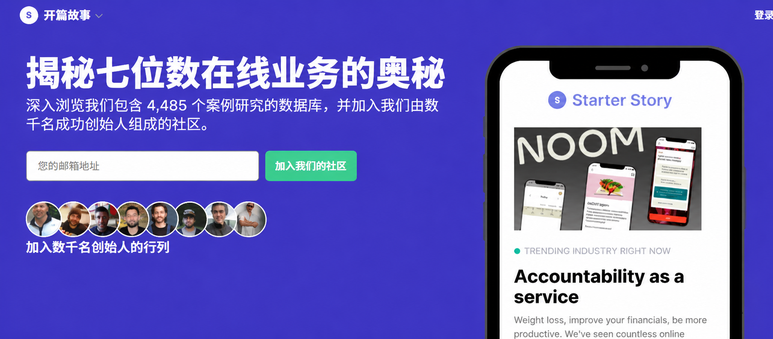
How Can a Socially Anxious Programmer Make a Million Dollars a Year by “Listening to Stories”?
This essay breaks down how Pat Walls built Starter Story into a million-dollar content business by collecting authentic founder stories, systemizing interviews, and selling readers a form of hope that feels specific and believable.
On this planet, nothing is worth more than "real human stories."
01 Chapter 1: The Silent Giant
If you are someone looking for ways to make money, you have definitely come across videos like this:
A polished-looking host sits inside a luxury car and tells you at lightning speed:
"How I made my first pot of gold in three months…"
Last year I made about 100 million. The project? Grinding in games.
My company is upstairs. Come on, I'll show you around.Or someone says to you:"The hottest opportunity in 2026 is definitely pets. Miss it and you'll wait another ten years!"
Pets, my ass.
Do you have the picture in your head now? I won't go looking for screenshots. You know they're selling courses, you know they're fleecing suckers, and you know the glossy exterior is probably a carefully designed script.
But the income they show off is terrifying: big Mercedes, big Land Rovers, teams of dozens of people. It looks like a proper company, more real than real.
Pay up. You absolutely have to pay! In this filthy, chaotic environment, one site I read often, Starter Story is as clean as a nun in a monastery.
(How did I end up writing in that dubbed-movie translation style?)Pat Walls, the founder of this site, is neither a marketing guru nor a traffic influencer. He is even a little socially anxious.

What he does even sounds a little "dumb":send emails, interview people, organize the text, publish it on a website.
It is extremely simple. At the very beginning, he just emailed people, asked whether they were willing to share their stories, wrote them down if they agreed, and posted them on his own site.
For example:
"John, originally a carpenter, makes $5,000 a month selling handmade guitar stands."
"Sarah, a full-time mom, commercialized her family's ancestral hot sauce recipe and now makes $100,000 a year."
This plain-looking text website has now passed 5 million visits and more than $1 million in annual revenue (about RMB 7.2 million).
And the profit margin is extremely high, almost all net profit.
After all, content writing does not cost much.

02 Chapter 2: Why Are People Willing to Work for You for Free?
He did every "against human nature" thing right, yet won the broadest part of human nature.
Starter Story has one thing outsiders find hardest to understand:where the content comes from.
Pat Walls does not write the articles himself. His site has thousands of in-depth long-form pieces averaging more than 3,000 words, all written for him by entrepreneurs for free.
The screenshot in the left box is also from Justin Welsh, a blogger I often read.
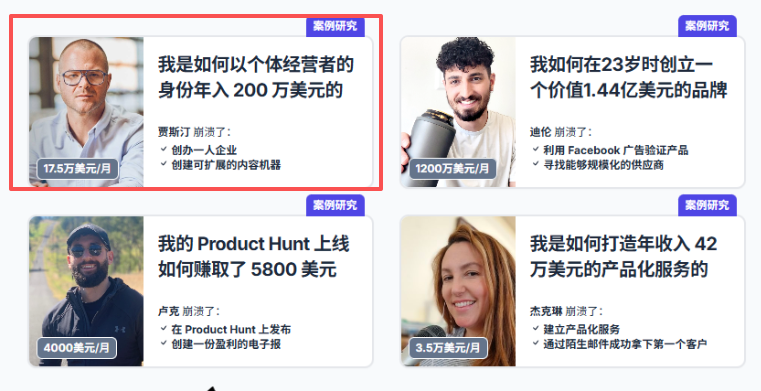
If you think about it with the mindset of a "rational economic person," it does not seem realistic.
"Why should I tell you my hard-earned startup experience for free, just so you can use it to make traffic money?"
If we look back with hindsight, we can understand it this way.
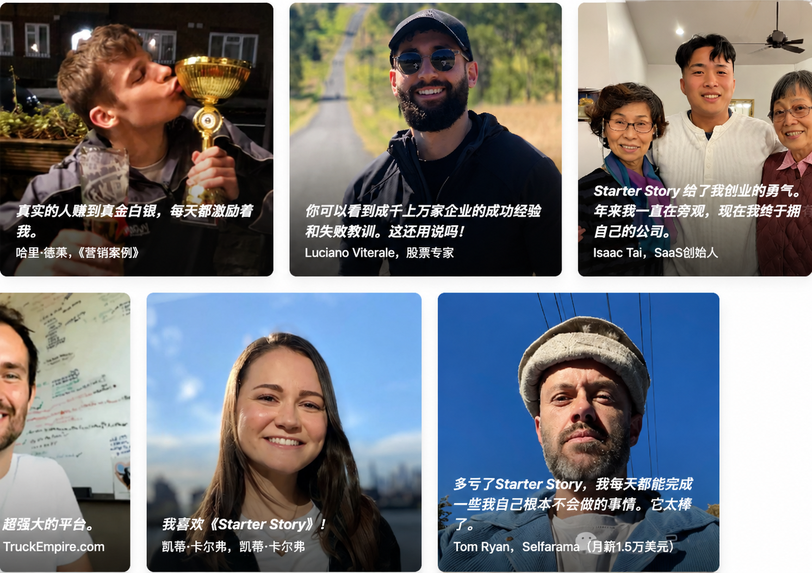
The "island effect" of entrepreneurs
In this era, entrepreneurship is extremely lonely.
When you are an indie developer or a small shop owner, after pulling countless all-nighters, finally shipping the product, and finally making your first money,
you look around and your family does not understand why you are excited. Your friends think you are not doing real work.
You are on a huge "social island".
Basically, you have nowhere to say it, and no one to say it to.
But when you do want to talk to someone for a few sentences, who do you tell?
At that moment, Pat Walls's email appears: "Hey, I'm an editor at Starter Story.
I came across your product, and it is genuinely impressive.
We would like to include your startup story in our 'Annual High-Potential Projects Library,'
so hundreds of thousands of readers can see your work. Would you be open to an interview?" Maybe you would, maybe you would not.
That is not important. What matters is that there is an outlet for emotion, and I think that is the most important part. Look at how many creators on Twitter share their content and revenue. The reason is actually simple: in their offline social circles, they have no one they can tell. An "interview" is the highest form of social currency.
Although Pat is asking for content, he packages himself as a "giver."
He gives entrepreneurs three things:
Vanity: "I was covered by the media." No matter how big that outlet is, this kind of link can be posted to Moments as a flex, and it can even help with future fundraising and acquisitions.
Backlinks: People who know the game understand that Starter Story's high-authority backlink can improve their own site's Google ranking. That is a real benefit.
Traffic: Even a 1% conversion rate can bring real customers.
So this is a relatively fair, mutually beneficial exchange.
The entrepreneur gets onstage and performs.
Pat gets the content, and the entrepreneur gets the applause. Research first, respect first
At the execution level, Pat shows his programmer side.
An ordinary interviewer would throw you a blank Word document: "Please write down your story." Where do you start? No idea. You just stare at it, confused.
Most likely, it goes nowhere. What does Pat do?
He first crawls through your website, LinkedIn, and Twitter.
In the form he sends you, he has already filled in 30% of the content for you.
Project name: already filled in.
Founder bio: already filled in.
Core data: already filled in.
You only need to fill in the remaining 70%.
And his questions are designed to be extremely leading:
He does not ask: "What is your business model?" (too abstract)
Instead, he asks: "How did it feel the moment you made your first dollar?" (concrete and emotional)
This "half-finished product strategy" is very simple.
You only need to fill in the blanks according to his way of thinking.
That is why he can get thousands of busy CEOs to sit down obediently and write thousands of words for him.
03 Chapter 3: Selling "Replicable Hope"
Now that we have figured out where the content comes from, let's look at the audience.
Why does Starter Story get so much traffic? If we open high-end media or 36Kr, what do we see?
"Burning 50 trillion tokens a day, Volcano Engine xxxxx."
"Don't Chinese large models believe in miracles created by brute force?"

These stories are grand and shocking. After reading them, you are likely to feel: ah, humanity has fucking progressed again, and once again it did not bring me along. Pure gods-fighting-gods stuff.

AI-generated images are so convenient! Survivorship Bias vs. Perceived Reality
Starter Story does the opposite.
It does not cover unicorns; it covers "cockroaches" (small businesses with stubborn vitality).
The stories it tells look like this:
A liberal arts student who does not know how to code used No-Code tools to build a recruiting website and makes $2K a month.
A couple quit their jobs to sell eco-friendly toothbrushes. After three failures, they now make $50K a year.
These stories are full of "flaws".
They write about getting yelled at by customers until they cried because they shipped the wrong item, and about being so anxious late at night that they could not sleep.
After reading them, readers think: isn't this basically like me? Holy shit! So I can do this too! "Hope" is the most powerful addiction mechanism humans have.
When you look at Musk, you think: "He is a genius. I cannot learn that."
But when you look at that couple selling toothbrushes, you think: "They do not even look smarter than me. If they can do it, I can do it too."
This emotional value is worth more than any course.The essence of the long-tail effect is "specific anxiety"
From a technical perspective, Pat Walls built a massive number of long-tail keywords.
His material library accumulated slowly over time.
Search in English for almost any startup project, and his content will rank.
He stacks thousands of cases directly in front of you.
If 1 is not enough, use 100. If 100 is not enough, use 1,000.


04 Chapter 4: Domestic Competitors
There are also people in China who do business interviews very well, such as Cheng Qian and Luo Yonghao.

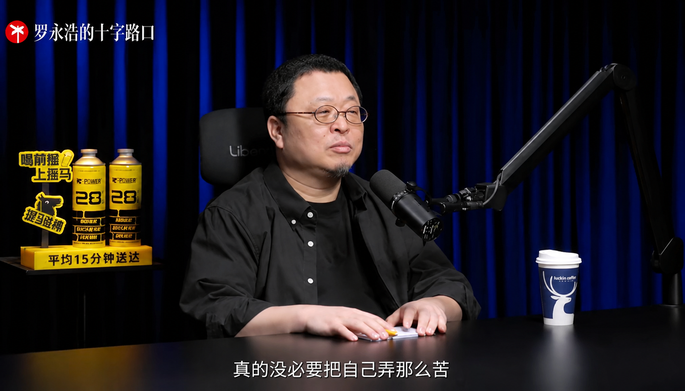
But at the core, they are different.
Luo Yonghao has had his public image collapse countless times, so maybe he is no longer afraid of it collapsing.

When you have time, you can watch their YouTube channels. They are pretty inspiring too.
They do remote interviews with bald guys like this.
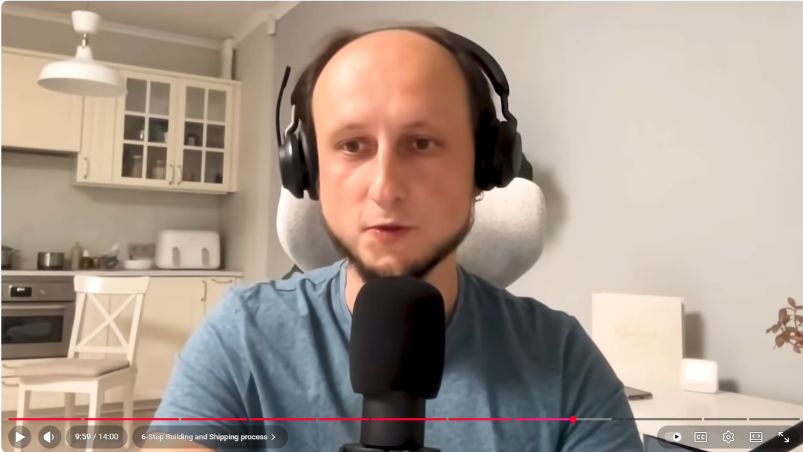
There is some production value, but not much.
Any random Chinese creator could go abroad and immediately crush their video production quality.
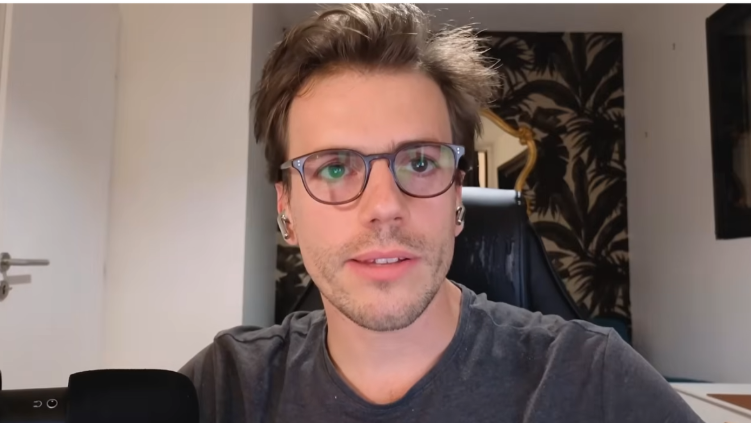
They are not really doing media; they are building a company with the logic of writing code.They refactored "content creation," an energy-hungry process that depends heavily on CPU, into an IO-intensive automation script.
This also gives ordinary people like us a huge lesson:
Do not try to become the star everyone is staring at. Become the foreman who builds the stage.
Influencers come and go; the stage stays. (Record the good life.)
05 Chapter 5: When AI Can Generate Everything, What Should We Sell?
Now we must face the elephant in the room: AI.
If I ask AI to write a startup story about "how to open a candle shop," it can write one even more perfect than a real person.
The logic is smooth, the punchlines keep coming, and even the fake data can be made to look convincing.
So, will the Starter Story model die?
The low-end version will die, but real "authenticity" is about to soar. "Dead Internet Theory" and the collapse of trust
The internet today is turning into a cesspool.
The articles you find are written by AI, videos are edited by AI, and even the "positive reviews" in the comments are generated by AI.
Humans have fallen into an unprecedented "crisis of trust."
"A real person" has become the most expensive luxury.

Who would dare put a photo of themselves like this on a website? AI definitely would not do something like that.AI can generate text, images, voice, and video, but AI cannot generate:
A blurry phone photo with fingerprints on it.
A self-deprecating ugly selfie.
The real emotion of crying late at night because a startup failed.
In the AI era, inspirational fluff is the cheapest thing there is.
Since AI is becoming more polished and more human-like, what about the things that do not look human? There is another even sharper idea, one I picked up from casually reading foreign media.
Since everyone likes to hear nice things, sell the truth.
In a world full of fake praise, "critical feedback" has become scarce.
Build a website called Savage Reviews.
Free version: I praise you. I put you on the website for display (satisfying your desire for exposure).
Paid version ($49): I roast you. I will use the harshest, pickiest, most honest eye to tell you why your website looks like a pile of shit, why your pricing strategy will not make money, and why your project will not survive three months.
After all, praising people does not take brainpower. Finding problems requires brainpower, time, energy, and actually solving business problems. In the end, the story of Starter Story does not really have much to do with technology. It is a story about "connection."
In this atomized society, every one of us is an island.
What Pat Walls did was simply build bridges between those islands.
Listen, record, organize.
In this noisy world, become a quiet "guardian of the real."
| Model | Features |
|---|---|
| Cheng Qian Model | It pays to buy interviews. |
| Polished video production | |
| Every video is a one-off piece that cannot be replicated. | |
| And it has to be tied to Cheng Qian. Once that person is gone (or his image collapses), the whole show is gone. | |
| Extremely high risk and extremely poor scalability. | |
| Starter Story Model (SaaS) | It is an industrial product. |
| Pat Walls is invisible. Readers do not care who runs the site. | |
| Every story uses a standardized structure: result, story, result. | |
| It is decentralized. Entrepreneurs around the world are his "content production nodes." | |
| Extremely low risk and unlimited scalability. |