
90% of SEO Competitor Analysis Is Wrong: A 5-Layer Reverse-Engineering Framework
Ask an SEO professional how to analyze competitors and you will probably hear something like this: plug a competitor into Ahrefs, find the keywords they rank for, and target those same terms yourself.
Is that competitor analysis? No. It is a keyword list.
Real SEO competitor analysis means reverse-engineering a competitor’s entire strategy across five layers: which keywords they chose and why, how they organize content, where their backlinks come from, how their technical architecture supports search performance, and how their conversion path turns traffic into leads.
The goal is not simply to see what they did. It is to understand why they did it—and what it costs you if you do not.
This guide breaks down a complete five-layer reverse-engineering method. It is not just theory. It is based on a B2B export company’s independent website that used the framework to grow monthly inquiries from 12 to 47 in three months.
The Real-World Problem: “He Ranks First, I Rank Second—Every Time”
Chen had been running an independent export website for industrial valves for two years. His products were solid, he had put real effort into the site, and he had studied plenty of SEO tutorials. But there was one competitor he could never get past: a company called ValvePro.
No matter which keyword Chen targeted, ValvePro seemed to rank ahead of him. For the same product term, ValvePro ranked No. 3 while Chen ranked No. 11. For the same technical blog topic, ValvePro ranked No. 5 while Chen could not break into the top 20.
Chen tried everything he could think of. He copied ValvePro’s title structure, imitated its article outlines, bought more backlinks, and even rewrote his product pages to sound more like ValvePro’s. After three months of effort, his rankings had barely moved—and his traffic had actually declined slightly.
What went wrong?
Chen had only studied ValvePro’s visible surface: titles, copy, and page layouts. He had missed the underlying strategy: how keywords were layered across the site, how content was organized into topic clusters, which channels produced backlinks, how the technical architecture supported indexing, and how the conversion path was designed.
The core idea: Competitors do not outrank you because they do one thing better. They outrank you because their SEO works as a system across five layers. Improving only one layer has limited impact. Improving all five together compounds the result.
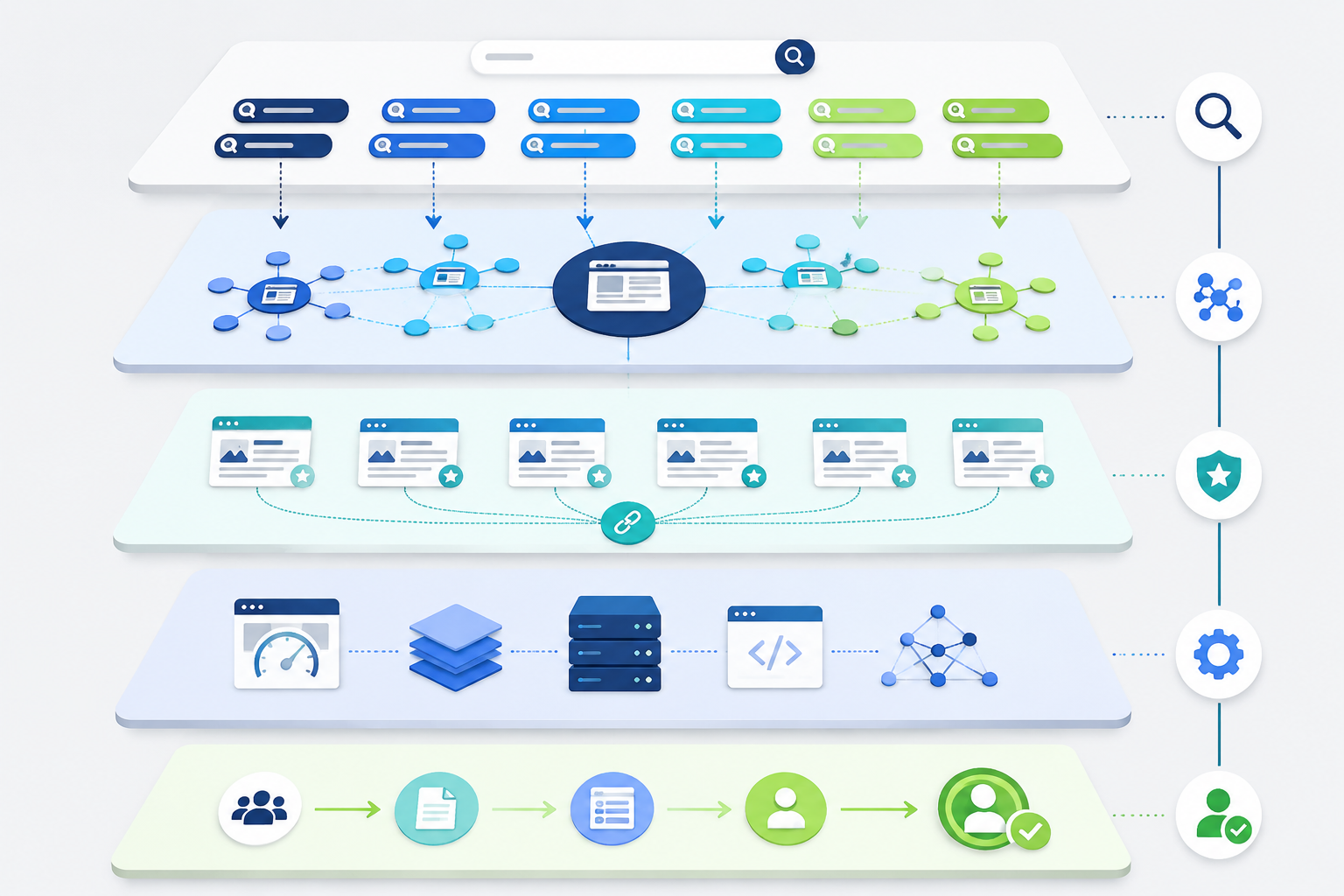
The Five-Layer Reverse-Engineering Framework
This framework moves from the visible surface to the underlying system. Each layer answers one essential question.
Layer 1: Keywords — What Did They Choose, and Why?
Most people do one thing: export every keyword a competitor ranks for from Ahrefs. A real keyword-layer analysis must answer three questions.
1. Where are the keyword gaps?
How many keywords rank for the competitor but not for us? What do their search volume, difficulty, and intent distributions look like?
2. How are the keywords layered?
A competitor’s keywords are not one undifferentiated pile. They typically fall into distinct layers: brand terms, product terms, technical terms, use-case terms, and comparison terms. Each layer maps to a different type of content and page.
3. What does the topic-cluster structure look like?
A strong competitor’s keywords are not scattered. They form clusters around a small number of core topics. Find those clusters and you have found the skeleton of the competitor’s content strategy.
Key finding: ValvePro ranked for 847 keywords that Chen did not, including 312 with clear transactional intent. More importantly, ValvePro had organized all of its content around five topic clusters, while Chen’s content was disconnected.
Layer 2: Content — How Is It Organized, and What Quality Signals Does It Send?
Keyword analysis tells you which terms a competitor targets. Content analysis tells you what it publishes to compete for those terms—and why that content ranks.
1. Publishing cadence
How many pieces does the competitor publish each month? What is the average length? How often are existing pages updated? The point is not to copy the cadence. It is to understand the competitor’s content-investment strategy.
2. Content-type mix
What percentage of the site consists of product pages, blog posts, case studies, technical documentation, and FAQs? Which type contributes the most organic traffic?
Chen discovered that ValvePro’s case studies and technical documentation generated 47% of its organic traffic. His own site had almost no content in either category.
3. Quality-signal comparison
Compare average word count, structured-data coverage, internal-link density, image use, and FAQ coverage. More words are not automatically better. What matters is information density and originality.
Key finding: ValvePro published an average of 12 pieces per month, compared with Chen’s three. But volume was not the biggest gap. ValvePro’s case studies and technical documents were the real traffic drivers, while Chen depended almost entirely on product pages.
Layer 3: Backlinks — Where Do They Come From, and Why Can the Competitor Earn Them?
Backlink analysis is not a counting exercise. A profile with 487 links from junk directories can be less valuable than 37 strong links from respected industry publications.
1. Source profile
What percentage comes from guest posts, industry directories, news and PR, partner links, forums, and communities? The structure of the backlink profile matters far more than the raw total.
2. Anchor-text distribution
Compare brand anchors, generic anchors, exact-match anchors, and semantically related terms. If exact-match keyword anchors are too concentrated, they can look like a manipulation signal. In a healthy backlink profile, branded anchors should generally account for more than 50%.
3. Growth rate and quality
How many referring domains are added each month? What does the DR distribution look like? Are there sudden spikes that suggest purchased links? Does growth appear natural?
Key finding: Of ValvePro’s 487 referring domains, 32% came from industry-focused guest posts on sites with DR above 50. Of Chen’s 89 backlinks, 62% came from low-quality directories. ValvePro had 5.5 times the volume, but the quality gap was easily greater than 10 times.
Layer 4: Technical SEO — How Does the Site Architecture Support Search Performance?
Technical SEO is the layer most often ignored by independent B2B export sites. Even excellent content will struggle to be indexed and ranked if the foundation is unstable.
1. Site architecture
Review URL depth: how many clicks does it take to reach a content page from the home page? Is the internal-link structure flat or deeply nested? Is breadcrumb navigation implemented consistently?
2. Core Web Vitals
Do LCP, INP, and CLS all pass? How much faster are the competitor’s pages? How does the site perform on mobile?
3. Structured data
Which Schema types does the competitor use? Measure coverage for Product, FAQ, BreadcrumbList, Organization, and Article markup. In 2026, structured data is one of the key signals that can help content become a source for AI Overviews.
4. Indexing status
What percentage of pages is indexed? Are many pages crawled but not indexed, wasting crawl budget? Is the sitemap complete? Is robots.txt configured correctly?
Key finding: ValvePro passed all three Core Web Vitals; Chen failed all three. ValvePro’s indexation rate was 91%, compared with Chen’s 68%. That 23-point gap meant nearly one-quarter of Chen’s pages had effectively been written for nothing.
Layer 5: Conversion — How Do They Turn Traffic Into Inquiries?
SEO is not only about traffic. A competitor ranking above you is bad enough. A competitor ranking above you while converting at three times your rate is far more dangerous.
1. Landing-page design
What do visitors see above the fold: product specifications, use cases, customer stories, or something else? Visitors with different intent should see different first-screen information.
2. CTA placement
How many CTA touchpoints appear on each page, where are they placed, and what do they say? “Contact Us,” “Get a Quote,” and “View Technical Specifications” carry different levels of specificity and intent. CTA copy directly affects conversion.
3. Conversion path
How many fields are in the inquiry form? How many steps does it take? Does a multistep form reduce the initial psychological barrier? Is live chat available for an immediate response?
Key finding: ValvePro’s inquiry form had five fields: name, email, company, product, and message. Chen’s form had 11, also requiring a phone number, job title, country, purchase quantity, budget, and website. Each field removed can improve conversion by roughly 15%.
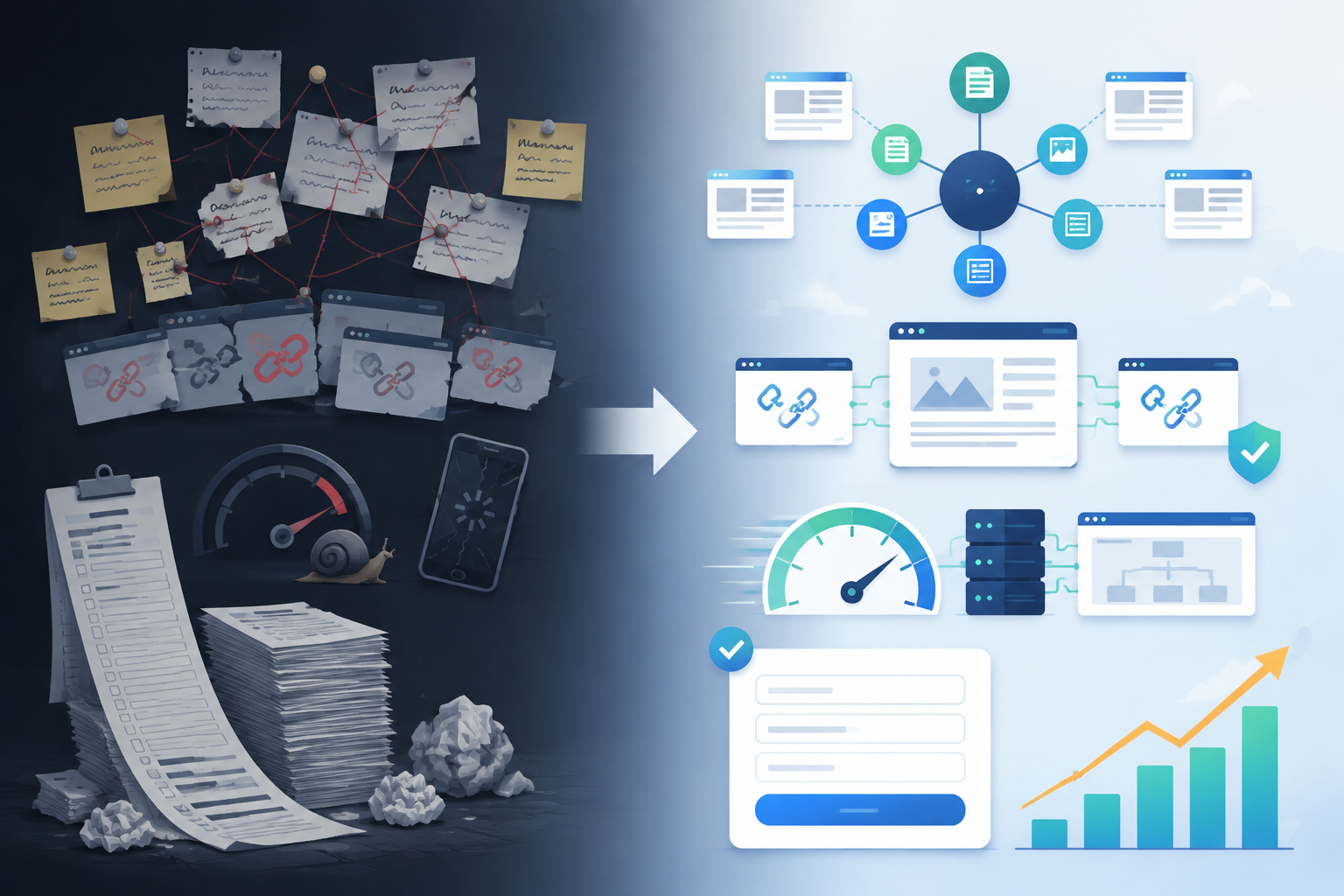
What the Five-Layer Analysis Revealed
Here is the core data Chen uncovered after completing the five-layer analysis of ValvePro. Every number pointed to a concrete optimization opportunity.
Chart 1: Summary of Core Findings
| Analysis layer | Core finding | Impact | Actionability |
|---|---|---|---|
| Keywords | 847 keyword gaps; 312 had transactional intent | ★★★★★ | Start immediately |
| Content | Case studies + technical documents generated 47% of competitor traffic | ★★★★ | Launch within two weeks |
| Backlinks | 32% high-quality guest posts vs. 62% low-quality directories | ★★★★★ | Plan over three months |
| Technical | All three CWV metrics failed; indexation lagged by 23 points | ★★★★ | Fix within one week |
| Conversion | 11 form fields vs. 5; one-third as many CTA touchpoints | ★★★ | Start immediately |
Chart 2: Optimization Opportunities Identified by Layer
| Opportunity type | Count |
|---|---|
| Keyword gaps | 847 |
| Content gaps | 34 |
| Backlink gaps | 39 |
| Technical issues | 8 |
| Conversion optimizations | 12 |
Chart 3: Competitor Backlink Source Distribution
| Source type | Share |
|---|---|
| Guest posts | 32% |
| Industry directories | 24% |
| News and PR | 18% |
| Partners | 14% |
| Forums and communities | 8% |
| Social signals | 4% |
Chart 4: Results Before the Analysis vs. Three Months Later
| Metric | Before | After three months | Change |
|---|---|---|---|
| Monthly organic traffic | 3,200 | 7,840 | +145% |
| Ranking keywords | 396 | 823 | +108% |
| Monthly inquiries | 12 | 47 | +292% |
| Inquiry conversion rate | 2.1% | 4.8% | +129% |
Chart 5: First-Page Keyword Growth During the Six Months After the Strategy Shift
| Month | Keywords ranking in Google’s top 10 |
|---|---|
| Month 1 | 23 |
| Month 2 | 38 |
| Month 3 | 67 |
| Month 4 | 98 |
| Month 5 | 134 |
| Month 6 | 187 |
How to Put the Framework Into Practice: A Five-Step Process
The five-layer framework tells you what to analyze. The five-step process tells you how to do it. Follow the sequence, and produce a clear deliverable at every step.
Step 1: Identify Three to Five True SEO Competitors
Not every company selling a similar product is an SEO competitor. A true search competitor should meet three conditions:
- It appears on the same search results page when you search your core keywords.
- Its target audience overlaps with yours.
- Its website is similar in size or slightly larger. Do not benchmark a site with 500,000 monthly visits against one with 3,000; the comparison will have limited value.
Tools: Ahrefs Competing Domains plus manual Google searches for validation.
Deliverable: A list of three to five competitor domains.
Step 2: Reverse-Engineer the Keyword Layer With Gap Analysis
Enter your domain and three to five competitor domains into Ahrefs Content Gap, then select the keywords your competitors rank for but you do not.
After exporting the results:
- Sort by search volume and isolate terms with more than 100 monthly searches.
- Classify each term by intent: informational, navigational, transactional, or commercial investigation.
- Group terms into topic clusters to reveal the competitor’s content skeleton.
Deliverable: A keyword-gap list and topic-cluster map.
Step 3: Reverse-Engineer the Content Layer With an Audit and Quality Comparison
Use Ahrefs Top Pages to identify the competitor pages with the most traffic and strongest rankings. Then open those pages and audit them manually.
Record the content type—product page, blog post, case study, or technical document—along with length, structured-data use, internal-link density, and use of images and video.
The priority is to find high-performing content types your competitor uses but you do not.
Deliverable: A content-analysis table for the competitor’s top 20 pages and a content-gap list.
Step 4: Reverse-Engineer the Backlink Layer With Source and Anchor Analysis
Use Ahrefs Backlinks and Referring Domains to study four dimensions:
- Source-type distribution: guest posts, directories, PR, partners, and forums.
- Anchor-text distribution: branded, generic, exact-match, and semantically related anchors.
- Backlink growth rate and whether the curve looks natural.
- The specific pages providing high-quality links—these are channels you may also be able to pursue.
Deliverable: A backlink-source profile and a list of replicable acquisition channels.
Step 5: Reverse-Engineer the Technical and Conversion Layers
Technical layer: Use PageSpeed Insights to compare Core Web Vitals for your site and your competitors. Crawl competitor sites with Screaming Frog to inspect URL depth, internal-link structure, and structured-data coverage. Use Google Search Console to compare indexation rates on your own site.
Conversion layer: Walk through the competitor’s full conversion path, from search click to inquiry submission, and document every step. Focus on above-the-fold information architecture, the number and placement of CTAs, form fields and steps, and the placement of trust elements.
Deliverable: A technical-gap list and a conversion-path optimization list.
Four Competitor-Analysis Traps to Avoid
Using the method incorrectly can be worse than doing no analysis at all.
Trap 1: Looking at Keywords Without Looking at Intent
You export 847 keywords from a gap analysis and immediately decide to target all of them. That is the most common mistake. Perhaps 500 are informational terms used by people who are only researching, while only 200 carry transactional intent. Targeting everything wastes resources and dilutes authority.
The right approach: Classify by intent first. Prioritize transactional and commercial-investigation terms, then use blog content to cover informational queries.
Trap 2: Confusing Copying With Analysis
You see a competitor article ranking No. 1, copy its title, make a few changes, and publish your own version. That is not analysis; it is imitation.
The point of reverse-engineering is to understand why the page ranks. Does it match intent better? Does it contain unique information? Is it supported by stronger internal links or greater backlink authority?
The right approach: Identify the reason, then create better content using your own data and cases—not an inferior copy.
Trap 3: Analyzing Only One Competitor
One competitor can give you a distorted picture. Different sites win with different strategies: one through content volume, another through backlink quality, and another through technical architecture.
The right approach: Analyze three to five competitors to distinguish industry norms—the strategies everyone uses—from the unique strengths of one competitor, which can reveal opportunities for differentiation.
Trap 4: Analyzing Without Acting
The most frustrating scenario is spending three days on a polished five-layer analysis, exporting a beautiful spreadsheet, and then doing nothing.
Analysis is only the first step. Execution is the dividing line. Chen did not triple inquiries in three months because his analysis looked impressive. He did it because he immediately took three actions: cut the inquiry form from 11 fields to five, published 20 technical documents, and cleaned up 89 low-quality backlinks.
Your SEO Competitor Analysis Action Plan
Do This Week
- Use Ahrefs Competing Domains to identify three to five true competitors.
- Run Content Gap for each competitor and export the keyword gaps.
- Use PageSpeed Insights to compare your Core Web Vitals with theirs.
- Reduce your inquiry form from 11 fields to five—make the change today.
Do Within Two Weeks
- Audit each competitor’s top 20 pages and create a content-gap list.
- Analyze competitor backlink sources and identify replicable channels.
- Classify keyword gaps by intent, prioritizing transactional terms.
- Crawl competitor sites with Screaming Frog and compare technical architecture.
Do Within One Month
- Create a three-month topic-cluster content plan.
- Launch a guest-post program with two to three placements per month.
- Fix every failing Core Web Vitals metric.
- Add the Schema types your competitors use and you do not.
- Add three CTA touchpoints to every product page.
Keep Doing
- Monitor competitor keywords monthly and track changes in the gap.
- Refresh the full five-layer competitor analysis every quarter.
- Continuously monitor new competitor backlinks and act quickly when you find a new channel.
- Review results monthly: which actions improved rankings, traffic, and inquiries?
Final Takeaway
The purpose of competitor analysis is not to copy. It is to understand the differences.
After completing the five-layer reverse-engineering process, Chen’s biggest insight was not the discovery of 847 keyword gaps. A tool could produce that data in three minutes. The real insight was finally understanding why ValvePro was strong.
ValvePro did not win because it excelled at one tactic. Its keywords were layered, its content was clustered, its backlinks came through intentional channels, its technical foundation supported indexing, and its conversion paths were designed to capture demand. The five layers reinforced one another as a complete SEO system.
Chen’s problem was not that one layer was weak. All five were fragmented, with no system connecting them.
The best competitor analysis should not end with you becoming the competitor. It should help you identify the advantages only you possess: a product line the competitor does not offer, deeper industry experience, or customer cases it cannot match. Turn those advantages into a systematic SEO strategy, and you have reached the real goal of reverse-engineering.