
From 3 Orders in 3 Months to Bestseller Creator: The Psychological Approach That Outperforms Every Data Tool
The Trap That Keeps Most Sellers Stuck
Every cross‑border e‑commerce seller knows the routine. Open your go‑to product research platform – Jungle Scout, Helium 10, or any of the dozens of data dashboards available. Filter by “trending now” or “high demand.” Pick a product with decent volume and manageable competition. List it, optimise keywords, run a few ads, and then… wait.
The waiting is the worst part. Even when you follow every “best practice,” the sales often don’t materialise. You blame the images, the price, the reviews. You tweak and test, but deep down you know you’re guessing.
That was exactly where our intern Sarah stood at the end of her third month. Three months, three orders. Her conversion rate was barely measurable. The team exchanged knowing glances – she clearly didn’t have “the eye” for this business. Nobody expected her to last much longer.
Then something shifted. Within a few weeks, Sarah went from the bottom of the performance board to the fastest bestseller creator in our entire company. When she finally explained what she had been doing differently, I was genuinely stunned – not because it was some high‑tech AI secret, but because it was so disarmingly simple that none of us had ever considered it.
The Fatal Flaw in Every Data Tool
Sarah’s breakthrough started with a question that seems obvious in retrospect but is almost never asked: Why do data tools fail to predict success?
The answer hit her one night while staring at her dashboard. Every tool she used showed her the results – products that were already selling, already validated by thousands of buyers. But none of them could show her the reason behind those sales. They gave her the “what” but never the “why.” They told her which products were popular, but they were completely blind to the psychological journey that made them popular in the first place.
Worse, by chasing products that had already peaked, she was always a step behind. She was copying yesterday’s winners, not creating tomorrow’s.
That realisation drove her to do something that seemed almost laughably low‑tech compared to the expensive software she had been using.
The Nightly Ritual That Rewired Her Brain
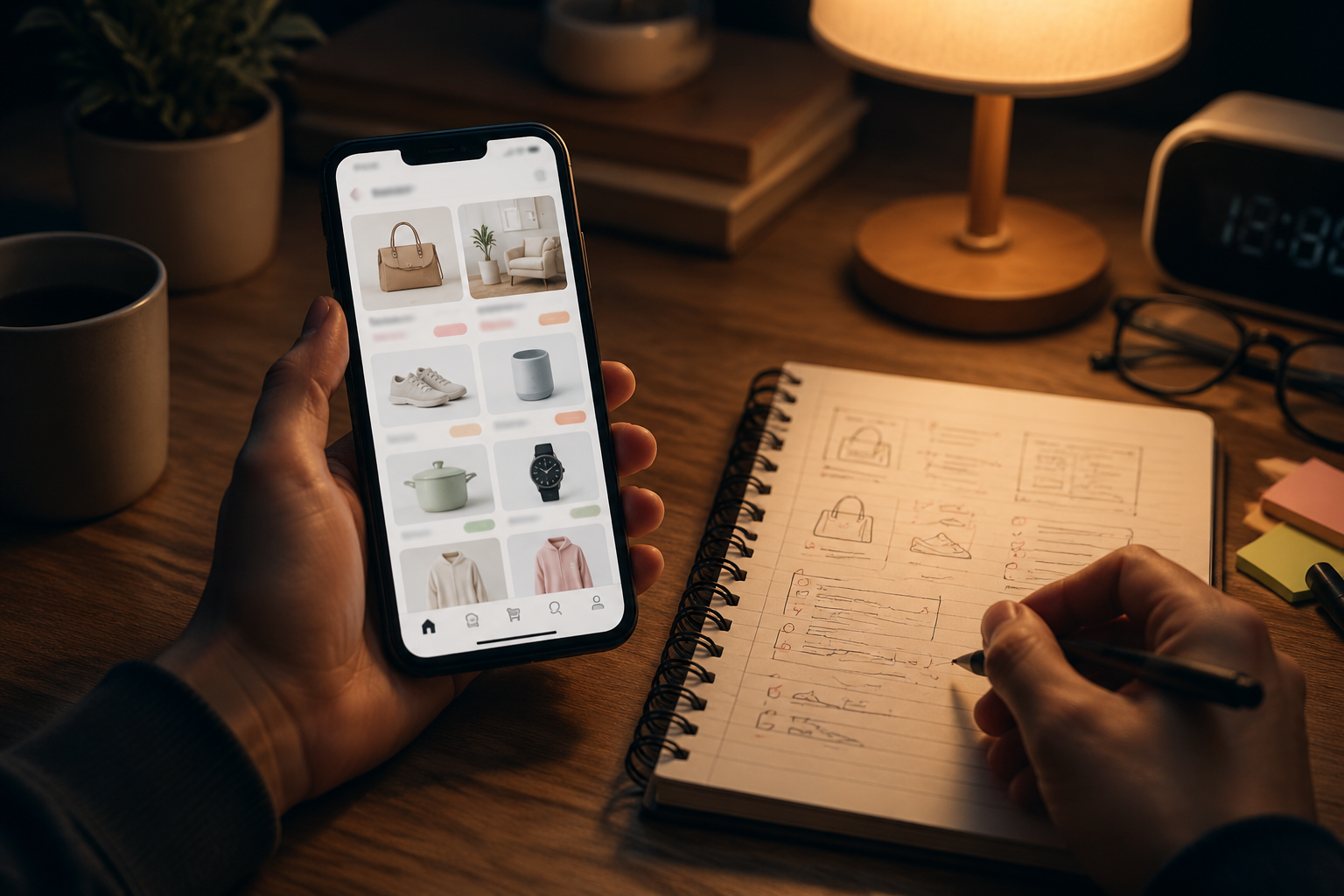
Every evening, after brushing her teeth and getting ready for bed, Sarah would sit down with her smartphone and a small spiral notebook. She opened the Southeast Asian shopping app that her target customers actually used – not the seller dashboard, not the analytics interface, but the genuine buyer‑facing app.
Then she started browsing. But she wasn’t shopping. She was studying.
For every product that appeared in her feed, she forced herself to slow down and document her own split‑second reactions. She asked herself four precise questions and wrote down the answers:
Where did my eyes land first on the main product image? (Top left? Centre? The model’s face? The product itself?)
Why did they stop there? (Was it contrast? Size? A face looking at her? Bright colours?)
What did I look at second? (Price? Reviews? The demonstration shot? A badge?)
And finally, what made me click in – or scroll past? (Was it curiosity? Trust? Confusion? Boredom?)
She didn’t just think about these questions – she wrote down every observation, every tiny hesitation, every instinctive “yes” or “no.” Night after night, she built a handwritten library of her own unconscious decision‑making.
When I asked her why she went to such lengths, her answer stopped me cold:
“Users don’t just have visual habits. Behind those habits are psychological needs that the buyers themselves don’t even realise they have. If I can train my own eyes to see what theirs see in those first two seconds, I can build images that speak directly to their subconscious – before their conscious mind even wakes up.”
The Eyebrow Pencil Example – A Masterclass in Subconscious Shopping

She illustrated her point with a product category she knew inside out: eyebrow pencils.
Imagine a woman scrolling through her feed. She wants an eyebrow pencil, but she hasn’t typed a search yet – she’s just browsing. A product appears.
What does she look at first? Not the product name. Not the price. Not the brand.
First, her eyes go straight to the demonstration image. Is it big enough? Can she clearly see the effect on a real face? If the image is small, cropped awkwardly, or blurry – she swipes away in less than a second. Her brain says, “Too much effort to figure this out,” and moves on.
Second, she studies the eyebrows themselves in that demo shot. Do they look natural? Do the strokes mimic real hair? Is the colour flattering on the model’s skin tone? If the brows look drawn‑on, patchy, or obviously filtered – she’s gone again. Her subconscious has already decided: “Not for me.”
Only after those two subconscious checks pass does she even glance at the price, the star rating, the number of reviews, or the product description. By that point, she’s already emotionally invested – she just needs rational confirmation to click “add to cart.”
The entire journey from first glance to click takes two to three seconds. And all of it is driven by what psychologist Daniel Kahneman famously called System 1 – the fast, instinctive, emotional part of our brain that operates automatically, without effort or conscious awareness.
Why Kahneman’s Nobel‑Winning Research Explains Everything
Daniel Kahneman won the Nobel Prize in Economics for his work on decision‑making, particularly the dual‑process model laid out in his international bestseller Thinking, Fast and Slow.
His core insight is that the human brain has two operating systems:
System 1 is quick, intuitive, and emotional. It makes snap judgments, recognises patterns, and drives most of our daily decisions – including what we buy. It is effortless but also prone to biases.
System 2 is slow, deliberate, and logical. It kicks in when we need to solve a complex problem, compare specifications, or justify a decision. But System 2 is lazy – it avoids effort whenever possible.
Here is the critical truth for e‑commerce: Almost every purchase decision begins and ends with System 1. Buyers do not rationally evaluate your product first. They react instinctively to your image, your layout, your visual clarity. Only after that instinctive “yes” does System 2 step in to confirm the choice with price checks and review scans.
If your product page forces buyers into System 2 too early – by presenting dense text, confusing angles, or unclear benefits – you create cognitive friction. Their lazy brain says, “This is too much work,” and they scroll on. You lose the sale before they ever read a single bullet point.
Sarah had never read Kahneman’s book, but she intuitively understood this principle. By training her own System 1 to notice what other people’s System 1 was doing, she effectively rewired her visual intuition. She stopped guessing what buyers wanted – she started feeling it in real time.
The Turning Point: How She Transformed Her Listings
After three weeks of nightly practice, something clicked. Sarah could look at any competitor’s main image and instantly spot its weak points:
The demo shot was too small – a clear barrier for first‑glance clarity.
The model’s skin tone didn’t match the product’s target audience.
The lighting was flat, making the product look cheap.
There was too much text overlay, distracting from the product itself.
The angle didn’t show the product in use – just a boring flat lay.
More importantly, she began to see opportunities. She redesigned her own listing’s main image with one question in mind: “What will my buyer’s System 1 see in the first two seconds?”
She made the demonstration image larger, cropped it to focus on the eyebrow detail, and used a model with skin tones representative of her core demographic. She removed all clutter – no badges, no “#1 Best Seller” stamps, no excessive text – because she realised those require conscious reading (System 2) and distract from the instinctive visual check. She even adjusted the colour temperature to feel warmer and more natural, because her notes showed that cooler tones made buyers hesitate.
The result? Her click‑through rate nearly tripled. Within two weeks of updating her main image, her product became the fastest‑selling item in our company’s history – beating seasoned sellers who had been in the game for years.
How You Can Replicate This Method Tonight
The beauty of Sarah’s approach is that it costs nothing and requires zero technical skills. Here is a step‑by‑step guide to start your own practice tonight:
Step 1: Choose Your Buyer’s Real App
Open the shopping app that your actual target customers use – not a seller tool, not a data aggregator. For cross‑border sellers, this often means regional apps like Shopee, Lazada, Tokopedia, or local equivalents. Browse exactly as a normal buyer would.
Step 2: Document Every Micro‑Decision
For each product you see, pause and write down:
Where did your eyes land first? (Be specific – “upper left corner,” “model’s face,” “price tag”).
What drew your attention there? (Size, colour, contrast, motion, a face?)
What did you look at second? (Another image, the title, reviews, the buy button?)
What made you click in – or what made you scroll past? (Was it clear confusion, lack of trust, boredom?)
Do this for at least 20–30 products per session. The act of writing forces you to slow down and observe what your subconscious usually does automatically.
Step 3: Identify Pattern Breaks
After a few days, review your notes. You will start seeing recurring patterns – certain image styles consistently catch your eye, while others consistently lose you. Note which elements trigger a positive instinctive reaction and which ones cause hesitation.
Step 4: Audit Your Own Listings
Now, go to your own product pages and look at them with the same critical eye. Ask yourself:
Is my main image instantly clear within one second?
Does it answer the buyer’s unspoken question (e.g., “Will this look good on me?”) without requiring effort?
Is there any visual clutter that forces the brain to work harder?
Redesign your images based on what you learned from your daily notes. Test one change at a time and monitor your click‑through and conversion rates.
Step 5: Repeat and Refine
This is not a one‑off exercise. The best sellers, like Sarah, make it a daily habit. Over time, your intuition sharpens until you can “feel” a winning image before you even launch it. That is the competitive advantage that no tool can replicate.
Why This Is Especially Critical for Cross‑Border Sellers
If you are selling across borders – say, from the US or Europe into Southeast Asia, Latin America, or other emerging markets – this method is even more powerful.
Local sellers in those regions grew up immersed in the culture. They intuitively know what catches their neighbours’ eyes, what colours signal trust, what visual styles feel familiar and safe. As an outsider, you do not have that luxury. But you can learn it – not from reports, but from deliberate, structured observation of how real buyers behave in their native environment.
Data tools cannot teach you cultural nuance. They only show you numerical trends. Sarah’s method bridges that gap by forcing you to step into the buyer’s shoes, literally one scroll at a time. It transforms you from a data‑driven copycat into a psychologically attuned creator.
The Bottom Line – Stop Chasing Data, Start Chasing Psychology
Sarah went from being the team’s underperformer to its most valuable contributor in a matter of weeks. She didn’t do it with a bigger budget, fancier software, or inside information. She did it with a phone, a notebook, and the willingness to stop looking at dashboards and start looking at people.
Her lesson is simple but profound: Data tells you where the fish are biting today. Psychology tells you why they bite – and that knowledge lets you cast your net exactly where they will bite tomorrow.
You can begin tonight. Open the app. Start documenting. Train your System 1 to see what your buyers’ System 1 sees. The insights are already there, hiding in plain sight, waiting for you to notice them.
And when you do, you will never rely on a data tool the same way again.